
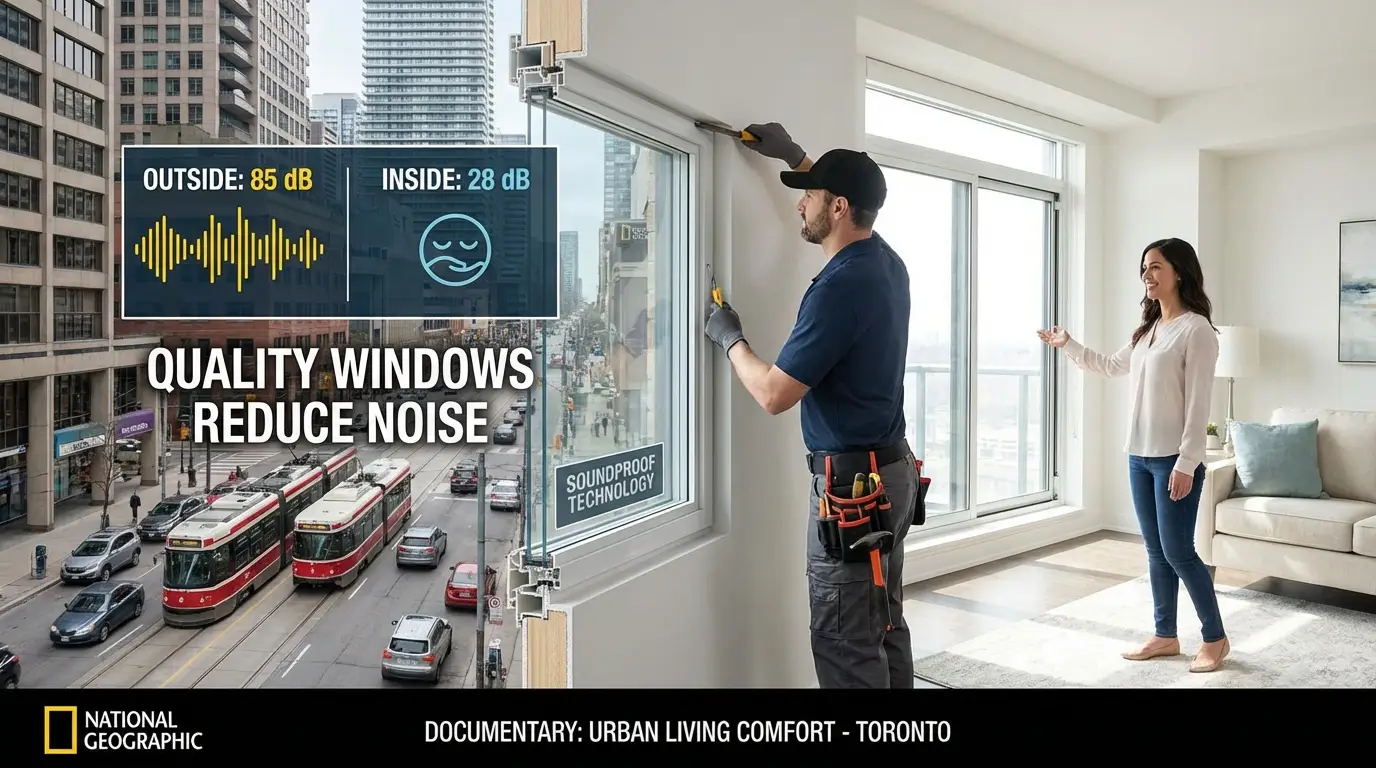
In the urban sprawl of downtown Toronto, street noise is an inescapable part of daily life. The constant hum of traffic, construction activities, and city bustle penetrates home environments, impacting residents’ comfort and well-being. Installing quality windows designed for noise reduction is a strategic response that many homeowners in Toronto, Mississauga, Vaughan, Brampton, Oakville, and Richmond Hill are embracing to create serene interiors without compromising the authentic urban lifestyle.
Beyond the immediate relief from intrusive external sounds, these advanced window systems contribute significantly to thermal insulation and energy efficiency, addressing Toronto’s diverse climate challenges. As city living evolves, investing in quality windows for noise reduction is not just about comfort but about enhancing long-term property value.
Key points in brief:
- Quality windows provide effective soundproofing against urban noise prevalent in downtown Toronto and surrounding GTA regions.
- Noise reduction strategies improve indoor comfort and support better sleep quality amidst ongoing city activity.
- Window upgrades including storm windows enhance sound insulation while guarding against Toronto’s seasonal weather extremes.
- Investment in window upgrades directly influences property longevity and energy efficiency, vital in Ontario’s climate.
- Professional assessments lead to tailored noise reduction solutions that respect home design integrity.
Understanding Why Quality Windows Significantly Reduce Street Noise in Downtown Toronto
Toronto’s downtown core is a dynamic environment, bustling with unparalleled activity. The street noise here ranges from heavy traffic and frequent construction projects to night-time urban vibrancy. These sounds infiltrate homes, impacting quality of life by disturbing concentration and sleep. However, the key to mitigating these effects lies in the technical design and installation of quality windows engineered for noise reduction.
At the core, quality windows designed for urban living employ multi-layer glazing, airtight frames, and advanced sealing technologies. These elements collectively form an effective barrier, significantly dampening sound vibrations transmitted from the bustling streets into home interiors. Such window systems have higher Sound Transmission Class (STC) ratings compared to standard double-pane windows. STC ratings measure a window’s ability to block out noise—commercial-grade soundproof windows available today can reduce unwanted sounds by up to 90%, a critical improvement for those living near busy streets, transit lines, or construction zones.
Beyond glass composition, the frame material is crucial. In Toronto’s climate, frames crafted from composite materials or vinyl coated with sound-absorbing cores prevent sound waves from “traveling” along rigid frame components. This contrasts with traditional aluminum or wood frames which, while durable, can transmit vibrations more readily if not properly treated. Moreover, attention to window installation impacts overall performance — poorly fitted units with gaps or compromised seals become sound “leaks,” reducing effectiveness noticeably.
Understanding these technical aspects helps Toronto homeowners realize that soundproof windows are a multilayered solution: the right glass, the correct frame type, precise installation, and integration with existing building envelopes all form part of a unified sound reduction strategy.

Advanced Technical Analysis: Sound Transmission Pathways and Window Insulation Strategies
Diving deeper into the science of noise intrusion reveals several critical pathways commonly underestimated by homeowners. Noise waves primarily infiltrate through window glass but equally through gaps at joints, frames, and mounting assemblies. Downtown Toronto’s urban noise features frequencies spanning from low rumbles of heavy trucks to high-pitched sirens and human chatter — each interacting differently with window components.
Quality windows achieve superior noise reduction by leveraging laminated glass layers combined with insulating air gaps. Laminated glass incorporates a polymer interlayer which dampens vibrations effectively. The asymmetry in glass thicknesses used in double- or triple-glazing units also disrupts sound wave patterns, enhancing attenuation.
Moreover, gas fills such as argon or krypton between panes provide dual benefits: thermal insulation and minor acoustic gains by disrupting sound wave transmission through the window unit. Frame seals utilize compressible weather stripping that maintains airtightness while accommodating thermal expansion and contraction due to Toronto’s varying seasons.
Installation techniques employ precise shimming and specialized acoustic caulking around window perimeters to seal unintended gaps. The structural integrity of mounting assemblies, including reinforced anchoring points that do not transmit vibration, contributes to reducing sound transfer from the external wall to interior spaces.
In high-rise condominium units or heritage buildings with custom window designs, retrofitting with storm windows made of performance glass can provide a layered sound barrier and protect original architectural elements without altering aesthetics significantly.
Taken together, these technical measures illustrate the holistic approach required to engineer window systems that genuinely improve urban noise challenges faced by Toronto area homeowners.
Top Professional Steps to Effectively Reduce Noise With Quality Window Upgrades in Toronto Homes
- Assessment of Existing Window Systems: Conduct a thorough diagnostic visit to evaluate current window conditions, insulation integrity, and existing noise leakage points.
- Choosing Laminated or Acoustic Glass: Select glass types with proven noise dampening properties such as laminated or acoustic glass that meets or exceeds local building codes for sound reduction.
- Frame Material Selection: Opt for state-of-the-art frame materials like vinyl with noise-absorbing inserts, engineered wood composites, or thermally broken aluminum to minimize sound transmission.
- Precision Installation: Employ calibrated installation practices ensuring tight seals and exact fitment to avoid air and sound leaks around frames.
- Integration of Secondary Storm Windows: Install custom-fit storm windows that add a secondary barrier without replacing existing windows, ideal for heritage or complex window profiles.
- Use of Acoustic Sealants and Weather-stripping: Apply high-quality sealants and weather-strips designed to block sound transmission edges effectively.
- Address Drafts and Leakage: Thoroughly seal gaps showing air infiltration to simultaneously improve energy efficiency and enhance noise reduction.
- Regular Maintenance and Inspection: Schedule annual check-ups to ensure all components retain their protective qualities amid Toronto’s humid summers and cold winters.
- Professional Diagnostic Visit: Book an expert inspection to tailor noise reduction solutions to your unique urban property needs in Toronto, Mississauga, or Vaughan.
Contractor Pro-Tip: When inspecting windows for noise reduction potential, pay close attention to the frame-to-wall connection. Even a small gap hidden behind trim can become a significant sound conduit. Applying acoustic sealant in these hard-to-see joints can improve noise reduction performance by up to 15% without expensive window replacement.
The CNG Professional Solution: Designed Noise Reduction for Toronto’s Urban Homes
At CNG Contracting, professionalism meets proven methods to deliver window upgrades that meaningfully reduce street noise across downtown Toronto and GTA neighborhoods. Our approach begins with a comprehensive onsite diagnostic visit to assess your home’s unique soundproofing requirements. This service includes a detailed evaluation of existing windows, building envelope, and external noise sources, helping us specify the best combination of laminated glass, frame upgrades, and installation techniques.
This diagnostic visit fee is fully credited toward your project’s final cost, ensuring that every step adds value without financial inefficiency. Our technicians utilize premium materials adapted to Ontario’s climate to secure soundproofing that also improves insulation—critical for reducing energy consumption in both winter and summer months.
Whether updating a modern condo in downtown Toronto or restoring character windows in Richmond Hill, our tailored window solutions protect your investment while enhancing daily living comfort by lowering intrusive urban noise levels.
For homeowners seeking a quiet, comfortable sanctuary amid the city’s action, booking a professional diagnostic visit with CNG Contracting is the definitive first step toward transformational window upgrades.
Technical Comparison of Noise Reduction Strategies for Toronto Window Upgrades
| Situation/Strategy | Risk Level | Proactive Benefit |
|---|---|---|
| Standard Single Pane Windows | High | Poor noise reduction, high energy loss |
| Double Pane Windows with Basic Frames | Moderate | Improved insulation but limited soundproofing |
| Laminated Glass Units with Airtight Vinyl Frames | Low | Significant noise reduction and thermal benefits |
| Retrofit with Storm Windows | Low | Enhanced sound barrier, protects primary windows |
| Full Window Replacement with Acoustic Glass and Composite Frames | Minimal | Top-tier noise reduction and energy efficiency |
Take Control of Urban Noise: Professional Window Upgrades in Toronto and the GTA
Urban noise can be intrusive, but it doesn’t have to define the comfort of your home. Homeowners in Toronto, Mississauga, Vaughan, and Brampton benefit from professional window noise reduction installations that respect architectural integrity while enhancing property value. Taking advantage of tailored window upgrade strategies aligns perfectly with long-term homeowner goals of peace and investment longevity.
For a detailed assessment and to explore your options, call (647) 669-7346 or visit the Contact Us page. Start your journey toward a quieter, more energy-efficient home today.
Technical Glossary of Key Terms for Window Noise Reduction
- Sound Transmission Class (STC): A numerical rating measuring how effectively a building material blocks airborne sound.
- Laminated Glass: Glass made by bonding two or more layers with a resilient interlayer that dampens sound vibrations.
- Acoustic Caulking: Specialized sealant designed to block sound transmission through joints and seams.
- Airtight Frame: Window frame construction that prevents air and sound leakage with tight seals and durable materials.
- Storm Window: A secondary window installed over existing windows to enhance insulation and improve soundproofing without full replacement.
Do quality windows completely eliminate street noise?
While quality windows dramatically reduce street noise, complete elimination is challenging in urban environments. However, these windows provide substantial sound attenuation to improve indoor comfort significantly.
Can storm windows be added to any existing window?
Storm windows are adaptable to most window configurations, including heritage and custom shapes, making them a versatile soundproofing and insulation addition in Toronto homes.
Is professional installation important for soundproof windows?
Professional installation ensures airtight seals, correct frame integration, and optimal performance of soundproof windows, which is critical for maximizing noise reduction benefits.
How do window upgrades impact energy efficiency?
Window upgrades with quality materials improve thermal insulation, reducing heating and cooling load on HVAC systems and lowering energy consumption during both Toronto’s winter and summer seasons.
What should be inspected during a noise reduction diagnostic visit?
Inspectors evaluate glass type, frame integrity, gaps, sealant condition, and mounting quality to identify sound leakage points and recommend appropriate window upgrade solutions.